English
AI Social Media Monitoring: From Detection to Response
Social media monitoring is not about dashboards. It is about finding conversations that matter and responding before competitors do. Learn the five-step workflow and how AI browser agents run it across platforms.

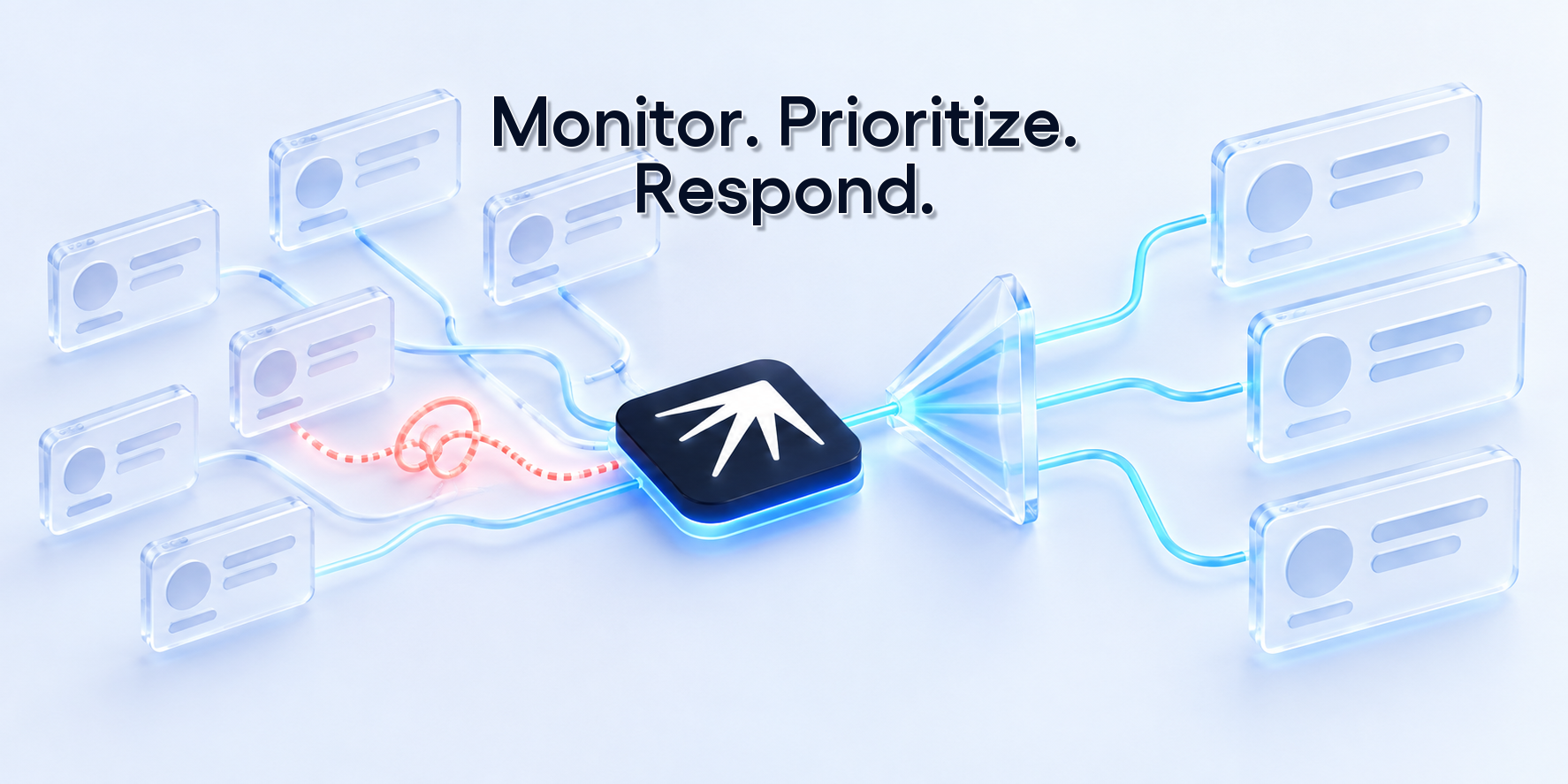
Social media monitoring is not about watching a dashboard. It is about finding the conversations where your brand, your competitors or your use case is being discussed and responding before the opportunity passes. A complaint on X that goes unanswered for a few hours can spiral into a thread that thousands of people see. A Reddit thread asking for alternatives to your competitor is a sales opportunity that closes in 24 hours. The value is not in collecting mentions. The value is in acting on them fast.
TL;DR: AI social media monitoring uses browser-based AI agents to find relevant conversations across platforms, understand context, triage by urgency and draft responses for human approval. Unlike API-gated listening tools, browser agents see everything a logged-in user sees, including content behind login walls and in private groups. Nextbrowser runs this detect-to-respond workflow across LinkedIn, X, Reddit, Instagram, Facebook and other platforms without API keys or rate limits.
What AI Social Media Monitoring Actually Is
Traditional social media monitoring means tracking mentions, hashtags and keywords across platforms and reporting them in a dashboard. Dedicated social listening tools like Brand24 do this well for public data accessible through platform APIs.
AI social media monitoring goes further. Instead of just collecting mentions, an AI agent understands the context of each conversation, decides whether it needs attention, classifies it by type (complaint, feature request, competitor mention, sales opportunity) and drafts a response in your brand voice. The human reviews and approves. The monitoring loop closes with action, not just awareness.
This matters because the bottleneck in social media management is never finding mentions. The bottleneck is reading 1,000 mentions, deciding which 80 matter, writing contextual responses and posting them without mixing up accounts or brand voices. That is the work AI agents eliminate.
Why Dedicated Listening Tools Fall Short
Social listening tools collect mentions through platform APIs. That means they miss content behind login walls: LinkedIn feeds, private subreddits, gated Facebook groups and Instagram comment threads are invisible. Worse, they collect but cannot act. Brand24 finds a mention, but you still have to open the platform, log into the right account, read the thread and write a reply manually. Multiply that by N mentions across M platforms and X client accounts.
Platform APIs also cap how much data you can pull and how often. At scale, those limits become the ceiling.
Browser-based AI agents skip the API entirely. They log into accounts, scroll feeds, read threads and see everything a logged-in user sees. The same agent that finds the mention can draft the response.
The Five-Step Monitoring Workflow
Whether you use AI agents or do it manually, effective social media monitoring follows the same five steps. The difference is how much of each step the AI handles.
Step 1: Define what to monitor
Before opening any tool, decide what matters. Most teams monitor three categories:
- Brand mentions. Your product name, common misspellings, your founder's name, your domain
- Competitor mentions. Competitor names, "alternative to [competitor]" threads, comparison discussions
- Pain-point keywords. The problems your product solves, described in the language your audience uses. "managing multiple accounts" matters more than "cross-platform social automation" because that is how marketers actually phrase the problem
Write these down as a monitoring brief. This becomes the prompt you give the AI agent.
Step 2: Choose platforms and frequency
Not every platform matters equally for every business. Pick 2–3 where your audience actually discusses the problems you solve:
- Reddit — open discussions, brutally honest opinions, high-intent "what should I use" threads
- LinkedIn — B2B decision-makers, professional recommendations, competitor frustrations in comment threads (often behind login walls)
- X/Twitter — real-time complaints, support requests, industry debates
- Facebook Groups — niche communities, local business discussions
- Instagram/TikTok — comment threads on competitor content, DM conversations
Set monitoring frequency based on urgency. Real-time for customer complaints. Daily for competitor mentions. Weekly for industry trend analysis.
Step 3: Collect and filter mentions
This is where most tools stop. An AI agent goes further: it reads the full thread (not just the mention), understands whether the conversation is relevant and filters out noise. A mention of "browser" in a web development subreddit is not the same as a mention of "browser" in a social media marketing forum. Context determines relevance.
Step 4: Triage by urgency and opportunity
Not every mention deserves a response. The AI agent classifies each finding:
| Type | Urgency | Action |
|---|---|---|
| Customer complaint | High | Draft empathetic response, escalate to support |
| "Alternative to [competitor]" thread | High | Draft helpful recommendation, queue for approval |
| Feature request or feedback | Medium | Log for product team, acknowledge publicly |
| Industry discussion mentioning your category | Medium | Draft thought-leadership response |
| Passing mention with no engagement opportunity | Low | Log and skip |
The triage step is what separates monitoring from intelligence. A dashboard shows you 200 mentions. Triage tells you which 5 need a reply in the next hour.
Step 5: Respond or escalate
The AI agent drafts a response tailored to the platform, the conversation context and your brand voice. You review and approve. The agent posts from the correct account.
This is the approval loop: the agent handles detection, context analysis, triage and drafting. The human handles the final quality check and the publish decision. One person can manage community response across multiple platforms and accounts without losing context or brand consistency.
How Nextbrowser Runs This Workflow
Nextbrowser orchestrates browser-based AI agents across your accounts. For social media monitoring, the workflow looks like this:
-
You describe the monitoring task in plain language. "Monitor LinkedIn for posts mentioning [competitor name] where people express frustration. Check every 4 hours. Draft a helpful reply that mentions how Nextbrowser handles [specific pain point]. Queue replies for my approval."
-
The AI agent opens a real browser session. It logs into the LinkedIn account, navigates to search, applies filters and reads through results. It sees everything a logged-in user sees, including comment threads, reactions and posts from connections.
-
The agent triages what it finds. It skips irrelevant results, flags high-priority conversations and classifies each by type (complaint, comparison question, feature discussion).
-
The agent drafts contextual responses. Each draft matches the tone of the conversation and the platform norms. A LinkedIn response reads differently from a Reddit comment. The agent adapts.
-
You review and approve. The agent queues drafts for human review. You read the conversation context, edit if needed and approve. The agent posts from the correct account with the right profile isolation.
-
The task runs on schedule. Set it to repeat every 4 hours, daily or weekly. Each run picks up where the last one left off.
Because Nextbrowser orchestrates multiple browser engines and proxy configurations, each monitoring account operates with its own fingerprint isolation. LinkedIn does not see that 5 accounts are being monitored from the same machine.
Example: Monitoring Competitor Mentions on LinkedIn
LinkedIn is one of the hardest platforms to monitor at scale. The feed is login-walled, the API is restrictive and most social listening tools return limited LinkedIn data. Browser-based monitoring solves this.
The scenario: An agency manages social media for a SaaS client. The client's main competitor just raised prices and users are complaining in LinkedIn comment threads. The agency needs to find these conversations and respond helpfully from the client's LinkedIn account.
The monitoring brief:
- Keywords: [competitor name], "alternative to [competitor]", "switched from [competitor]", "[competitor] pricing"
- Platform: LinkedIn
- Frequency: every 6 hours
- Action: draft a reply acknowledging the frustration and mentioning the client's product as an option, without being salesy
What the agent does:
- Logs into the client's LinkedIn account using an isolated browser profile
- Searches for the defined keywords in posts and comments
- Reads the full conversation thread for each result to understand context
- Filters: is this person a potential customer? Is the conversation recent enough to engage? Are others already recommending alternatives?
- Drafts a contextual reply for each qualifying conversation
- Queues the drafts for the account manager to review
What the human does:
- Reviews 3–5 drafted replies per monitoring run
- Edits tone or adds specific details the agent missed
- Approves and the agent posts
Without this workflow, the account manager would need to manually log into LinkedIn every few hours, run searches, read through dozens of posts and write custom replies. That is 30–60 minutes per run. With the AI agent, the human review takes 5–10 minutes.
Example: Catching Product Feedback on X
X is the opposite problem: content is mostly public but the volume is high and the platform's detection systems are aggressive against automated behavior.
The scenario: A product team wants to monitor X for user feedback about their tool. They care about three things: bug reports, feature requests and positive testimonials they can amplify.
The monitoring brief:
- Keywords: [product name], common misspellings, "[product] bug", "[product] feature", "[product] love"
- Platform: X
- Frequency: every 2 hours during business hours
- Action: classify each mention (bug, feature request, testimonial, other), draft a response for bugs and feature requests, flag testimonials for the marketing team
What the agent does:
- Opens an X session in an isolated browser profile
- Searches for keywords and reads the full conversation context for each result
- Classifies: this is a bug report (user describes unexpected behavior), this is a feature request (user asks "can you add..."), this is a testimonial (user shares a positive experience)
- Drafts empathetic responses for bug reports: acknowledges the issue, asks for details, links to the support channel
- Drafts acknowledgment responses for feature requests: thanks the user, notes the suggestion
- Flags testimonials in a separate queue for marketing to repost or respond to
What the human does:
- Reviews classified mentions — confirms the agent's triage is correct
- Edits bug-response drafts to include specific fix timelines if known
- Approves and the agent posts from the brand account
This turns X from a firehose of noise into a structured inbox sorted by action type. The product team gets bug reports without scrolling through compliments. The marketing team gets testimonials without reading complaints.
FAQ
Which platforms can Nextbrowser monitor?
Any platform accessible through a web browser. This includes Reddit, LinkedIn, X, Facebook, Instagram, TikTok, YouTube and niche forums. Because the AI agent operates a real browser session, it is not limited to platforms that offer monitoring APIs.
How does approval mode work?
When you set up a monitoring task with approval mode enabled, the AI agent drafts responses but does not post them. Drafts are queued for your review. You read the conversation context, edit the draft if needed and approve or reject. Only approved responses get posted. This keeps the human in the loop while removing the repetitive work of finding conversations and writing first drafts.
How is this different from dedicated social listening tools?
Social listening tools collect mentions through platform APIs. They show you a dashboard but cannot log into accounts, read login-walled content or post responses on your behalf. Nextbrowser's AI agent operates a real browser: it logs in, reads what a human would see, drafts responses and posts them after approval. It is the difference between a dashboard that shows you what happened and an agent that handles the response.
Can I monitor multiple brands or clients from one machine?
Yes. Each monitoring task runs in its own isolated browser profile with a unique fingerprint and proxy configuration. Platforms do not see that multiple accounts are managed from the same machine. Agencies commonly run monitoring for 5–10 clients simultaneously.
Does monitoring work while I sleep?
Monitoring runs as a scheduled task while the Nextbrowser desktop app is open. You can set tasks to run every 2 hours, every 6 hours or daily. The agent collects and triages mentions, drafts responses and queues them for your review when you are back. For a deeper look at scheduling and automated workflows, see AI Social Media Manager: How AI Agents Run Your Accounts.
Try Nextbrowser
- Download and install: GitHub Releases (Mac, Windows, Linux)
- Star the repo: nextbrowser-oss/nextbrowser-app
- Join the community: Discord
 NextBrowser TeamBrowser Fingerprinting Explained: What It Means for Your AutomationBrowser fingerprinting is the reason multi-account operations get detected. Learn what signals sites check, how anti-detect browsers handle them and why Nextbrowser orchestrates the right toolset so you don't have to.
 Nextbrowser TeamGoLogin vs Dolphin Anty vs Camoufox: Features, Pricing and VerdictA side-by-side comparison of GoLogin, Dolphin Anty and Camoufox covering fingerprint management, pricing, automation, team features and detection evasion. Includes a comparison table and a verdict on which tool fits which use case.
 Nextbrowser TeamWhat Is an AI Browser? Types, Tools and How to ChooseAI browsers range from smart research tools to autonomous automation agents. This guide breaks down the three types, compares the leading tools and helps you pick the right one for your workflow.