English
Browser Fingerprinting Explained: What It Means for Your Automation
Browser fingerprinting is the reason multi-account operations get detected. Learn what signals sites check, how anti-detect browsers handle them and why Nextbrowser orchestrates the right toolset so you don't have to.

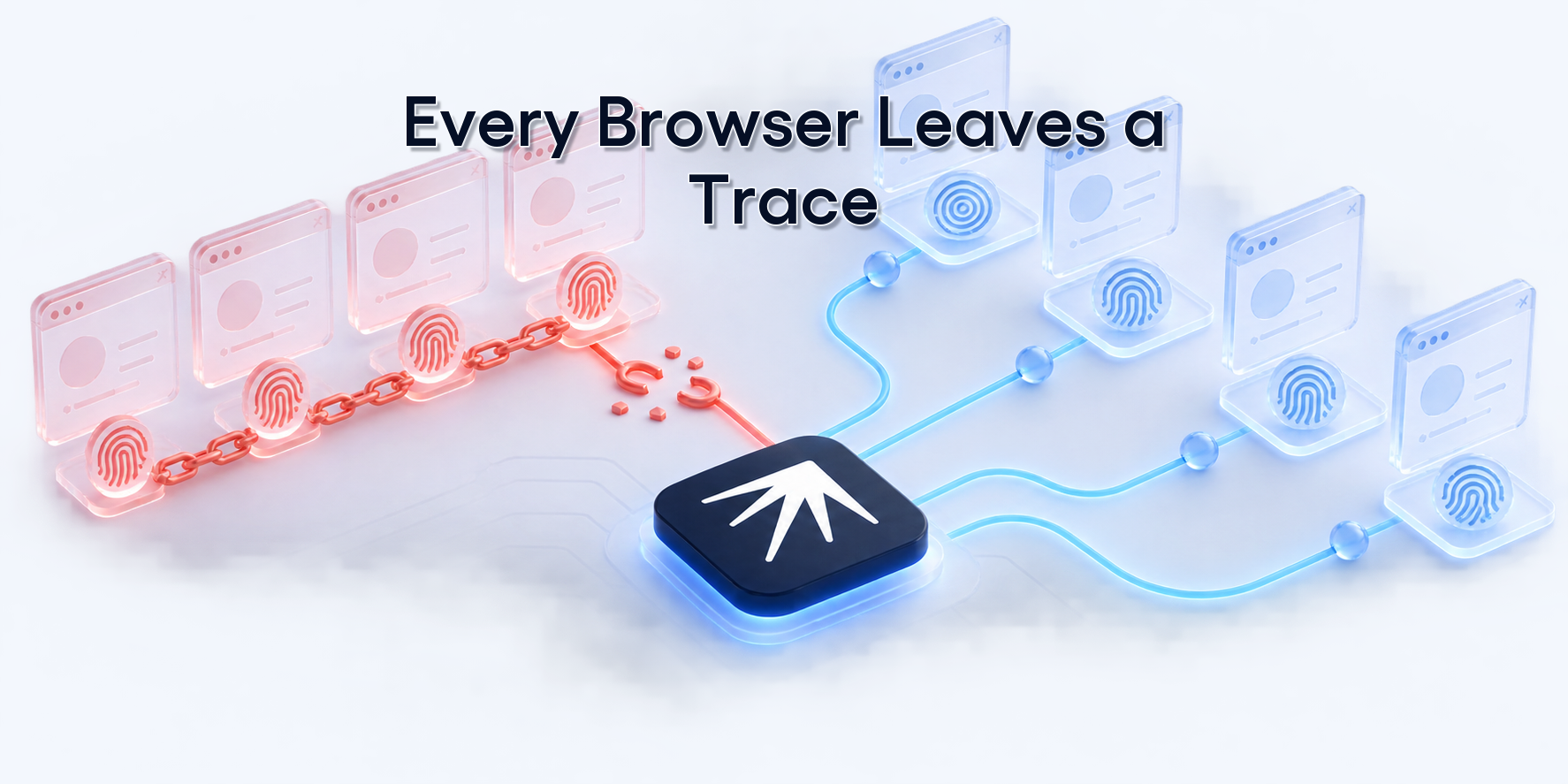
Browser fingerprinting is the single biggest reason multi-account operations get detected and banned. Every time your browser loads a page, the site collects dozens of signals about your device: screen size, installed fonts, graphics card output, audio processing behavior and more. Combined, these signals create a unique fingerprint that identifies your browser across sessions, even without cookies. If you run 10 accounts from the same machine without masking these signals, the platform sees 10 "different users" with identical fingerprints. That is an instant red flag.
TL;DR: Browser fingerprinting identifies your device by collecting hardware and software signals that are unique to your setup. Open-source anti-detect browsers like Clawbrowser and Camoufox solve this by giving each browser profile a distinct, coherent fingerprint. Nextbrowser orchestrates these anti-detect browsers automatically so you get working fingerprint isolation without configuring it yourself.
What Browser Fingerprinting Actually Is
Unlike cookies, which you can clear, browser fingerprinting reads hardware and software properties of your device that stay the same across sessions. When you visit a site, scripts query your browser for signals like canvas rendering output, WebGL vendor strings, AudioContext waveforms, navigator properties (User-Agent, CPU cores, device memory) and screen characteristics (resolution, pixel ratio, timezone). No single signal is unique on its own. Combined, 15 to 20 signals create a fingerprint that identifies your specific device with over 95% accuracy.
For a deep technical breakdown of all 20 signals that anti-bot systems check, including TLS fingerprinting, HTTP/2 frame ordering and WebRTC leaks, read Browser Fingerprinting Explained: The 20 Signals Anti-Bot Systems Use to Detect Automation on the Clawbrowser blog.
Why Fingerprinting Matters for Multi-Account Operations
If you manage multiple social media accounts, run outreach campaigns or monitor competitors across regions, you are running a multi-account operation. Platforms like Reddit, Twitter/X, LinkedIn, Facebook and Instagram actively fingerprint every session to detect this.
Here is how detection works in practice:
- You create 10 accounts from the same laptop using regular Chrome profiles or incognito windows.
- Each session shares the same fingerprint because your hardware, fonts, screen resolution and GPU output are identical.
- The platform correlates the sessions. Even with different logins, different IPs and cleared cookies, the fingerprint matches. The platform concludes all 10 accounts belong to one operator.
- Ban wave. All 10 accounts get suspended, often simultaneously.
This is not theoretical. It happens daily to affiliate marketers, agency teams and solo founders who try to scale without fingerprint isolation.
The key insight: clearing cookies and switching proxies is not enough. If the browser fingerprint stays the same, the platform can still link your accounts.
How Anti-Detect Browsers Solve Fingerprinting
Anti-detect browsers exist specifically to solve this problem. Instead of running all your accounts in the same browser, an anti-detect browser creates isolated profiles where each one presents a different fingerprint to the sites you visit.
Clawbrowser is a Chromium-based anti-detect browser built for AI agent workflows. Each profile gets isolated cookies, storage and a unique fingerprint. It includes built-in proxy routing, native Playwright support and a headless mode designed for automation. Clawbrowser handles fingerprint isolation at the browser level so the AI agent controlling it does not need to worry about detection.
Camoufox is an open-source Firefox fork that modifies the browser engine at the C++ level before compilation, making its anti-detection harder to spot than runtime JavaScript patches. For a detailed comparison of how Camoufox stacks up against Clawbrowser and commercial alternatives, see GoLogin vs Dolphin Anty vs Camoufox.
Both tools solve the same core problem: making each browser profile look like a genuinely different device.
The Real Problem: Fingerprint Coherence
Spoofing individual signals is the easy part. The hard part is making all the signals consistent with each other.
Modern detection systems do not check one signal at a time. They cross-reference dozens of signals looking for contradictions. If your browser reports a timezone of America/New_York but your proxy IP geolocates to Frankfurt, or your navigator claims 16 GB of device memory while your screen resolution matches a low-end Chromebook, those mismatches flag the session as spoofed.
This is called fingerprint coherence, and it is the difference between anti-detect browsers that work and those that do not.
A properly configured anti-detect browser ensures that every signal tells the same story: the User-Agent matches the rendering engine behavior, the screen resolution matches the reported device memory, the timezone matches the proxy IP's geolocation and the font list matches what that operating system would actually have installed.
Getting coherence right across 20+ signals is a hard engineering problem. It is not something you can configure manually for each profile. That is why purpose-built anti-detect browsers exist: they generate coherent fingerprint sets automatically.
For the full technical explanation of how coherence failures get detected across network, rendering, audio and navigator surfaces, the Clawbrowser deep-dive covers all 20 signals and real-world examples of what goes wrong when they contradict each other.
Where Nextbrowser Fits In
Nextbrowser is an open-source AI agent orchestrator harness that turns your existing browsers, proxies and AI agents into one self-healing automation system. It does not implement its own fingerprinting solution. That would mean building yet another single browser engine with yet another single point of failure. Instead, Nextbrowser orchestrates the anti-detect browsers that already solve fingerprinting well.
When you describe a task to Nextbrowser, it selects the right tool combination for the job:
- Need a Chromium-based profile with AI agent control? Nextbrowser routes the task to Clawbrowser.
- Need Firefox-based profiles with engine-level anti-detection? Nextbrowser routes to Camoufox.
- Need lightweight automation without anti-detection overhead? Nextbrowser uses Playwright directly.
- Need a real mobile fingerprint instead of a desktop emulation? Nextbrowser routes the task to a cloud Android phone with a genuine mobile browser stack.
This variety matters because no single anti-detect browser stays undetectable forever. Platforms update their detection systems constantly, so having multiple engines available behind one orchestration layer is the difference between a fragile setup and a resilient one.
For the full explanation of why single-tool automation is structurally fragile, see The Problem with Anti-Detect Browsers.
What This Means for Marketers
You do not need to become a fingerprinting expert to run multi-account operations safely. But you do need to understand what is happening under the hood so you can make informed tool choices.
Here is the practical takeaway:
- Regular browsers (Chrome, Firefox, Safari) offer zero fingerprint isolation. Every profile on your machine looks identical to detection systems.
- Anti-detect browsers (Clawbrowser, Camoufox, GoLogin, Dolphin Anty) solve fingerprint isolation. Each profile gets a unique, coherent fingerprint. This is the minimum requirement for running multiple accounts on any platform.
- Nextbrowser orchestrates multiple anti-detect browsers so you get fingerprint isolation without choosing and configuring individual tools. Describe the task, Nextbrowser picks the right browser and applies the right proxy. Because your accounts are spread across different browser engines and fingerprint stacks, a detection update that affects one tool does not take down your entire operation.
The goal is the same across all approaches: make each account look like it is running on a separate, real device. The difference is how much of that work you do manually versus how much the tooling handles for you.
FAQ
Is browser fingerprinting the same as cookies?
No. Cookies are stored files that you can delete. Browser fingerprinting reads hardware and software properties of your device that persist regardless of cookies. Clearing cookies does not change your fingerprint.
Can I prevent browser fingerprinting with a VPN?
A VPN changes your IP address and your TLS fingerprint (because the VPN tunnel renegotiates the TLS handshake), but it does not change your browser fingerprint. Detection systems use fingerprinting alongside IP and TLS tracking. Using a VPN without fingerprint isolation still leaves your accounts linkable through canvas, WebGL, audio and navigator signals.
Do I need an anti-detect browser for every use case?
Not necessarily. If you are running a single account on a single platform, standard browser hygiene is usually sufficient. Anti-detect browsers become essential when you manage multiple accounts on the same platform or need to avoid detection across sessions. For a broader look at when automation tools make sense, see Browser Automation: What It Is and How to Get Started.
What is the difference between Chromium-based and Firefox-based anti-detect browsers?
Chromium-based anti-detect browsers like Clawbrowser share Chrome's rendering engine and apply fingerprint modifications at runtime through JavaScript. Firefox-based anti-detect browsers (Camoufox) modify the engine at the source code level before compiling, making the spoofing harder to detect but limiting the browser to Firefox-compatible sites and workflows.
How does Nextbrowser choose which anti-detect browser to use?
Nextbrowser evaluates the task requirements, platform target and available tools. It selects the browser engine most likely to succeed for that specific task and platform combination. If the selected browser fails or gets detected, Nextbrowser automatically retries with a different engine. Over time, it learns which combinations work best for each platform through Solution Memory.
Try Nextbrowser
- Download and install: GitHub Releases (Mac, Windows, Linux)
- Star the repo: nextbrowser-oss/nextbrowser-app
- Join the community: Discord
 Nextbrowser TeamGoLogin vs Dolphin Anty vs Camoufox: Features, Pricing and VerdictA side-by-side comparison of GoLogin, Dolphin Anty and Camoufox covering fingerprint management, pricing, automation, team features and detection evasion. Includes a comparison table and a verdict on which tool fits which use case.
 Nextbrowser TeamWhat Is an AI Browser? Types, Tools and How to ChooseAI browsers range from smart research tools to autonomous automation agents. This guide breaks down the three types, compares the leading tools and helps you pick the right one for your workflow.
 Nextbrowser TeamMulti-Account Social Media Management: The Complete GuideA practical guide to managing multiple social media accounts safely and at scale. Covers account isolation, warm-up routines, AI automation and the three-layer stack that keeps accounts alive.